

Yes, hot yoga can help you lose weight when it contributes to a sustained pattern of physical activity and eating habits that supports fat loss. Sweating mainly changes your fluid balance, so a lower scale reading immediately after class is not proof that you lost body fat.
- Can hot yoga help you lose weight? Yes, through regular activity—not sweat alone.
- Sweat-related weight loss is fluid loss; rehydration changes the scale again.
- Choose Vinyasa, Yin, or another class for its movement and fit, not promised calorie burn.
- HHS adult activity guidelines provide a weekly framework; heated classes do not automatically meet every exercise goal.
Can hot yoga help you lose weight?
Hot yoga supports weight management through movement, not through heat acting as a fat-loss shortcut. Losing body fat requires a sustained energy deficit: over time, your body uses more energy than you consume. A class contributes physical activity, but it does not determine your entire energy balance.
For an American Fork newcomer considering Unified Hot Yoga, the useful question is whether you enjoy the class enough to return. The studio offers infrared-heated yoga, Hot Pilates, Barre, and Reformer Pilates for practitioners of all skill levels; none of those class names guarantees a weight-loss result.
| What changes | What it means | What it does not prove |
|---|---|---|
| Your weight drops immediately after sweating | You have lost fluid during exercise | That the change represents body-fat loss |
| You attend classes consistently | You have established a repeatable activity habit | That your overall energy balance supports weight loss |
| Your weight trends downward over time | Your body weight is changing beyond an isolated post-class reading | That every change comes from fat rather than fluid or other tissue |
| You handle familiar movements more comfortably | Your experience of the activity has changed | That the scale must change at the same rate |
Do not use a sweaty towel as a progress report. Judge the practice by your participation, how you tolerate it, and longer-term changes that match your goals.
Why this matters
A weight-loss goal can make the hottest or hardest-sounding class seem like the obvious choice. That is a poor selection rule. Heat adds a demand on your body's cooling system; it does not tell you whether the class provides the movement, instruction, or pace you need.
For your 2026 fitness plan, separate three questions: Do you enjoy the activity? Can you recover and return? Does your overall routine support your goal? A class that fits your life is more useful than an intense experience you dread repeating.
Community matters here in a practical way. Feeling comfortable asking questions and taking modifications helps you participate without treating every session as a test.
Sweat loss is not the same as fat loss
Sweat helps your body regulate temperature. When you sweat without replacing the fluid, your body weight can fall temporarily; drinking and eating afterward change that reading again. Deliberately restricting water to preserve the lower number is not a weight-management strategy.
Do not chase dehydration to make the scale move. Hydration supports safe participation, while fat loss depends on a longer-term pattern that cannot be judged immediately after class.
If you track body weight, compare measurements taken under similar conditions rather than weighing yourself before and after a heated session. If weighing causes distress or compulsive checking, discuss another way to monitor wellbeing with a qualified healthcare professional.
Does infrared heat make you burn more fat?
Infrared heating is not evidence of greater body-fat loss. The heating method describes the environment; it does not establish how much energy you use or whether you maintain an energy deficit.
Choose a heated class because you prefer practicing in that setting and tolerate it comfortably. Do not choose it because the word infrared sounds like a separate weight-loss treatment.
How many calories does hot yoga burn?
There is no single calorie figure that accurately describes every hot yoga participant and class. Body size, movement, effort, and session length affect energy use, so a fixed number attached to the class name creates false precision.
A fitness tracker provides an estimate, not a direct measurement of fat loss. Avoid treating its display as an exact amount you must replace with food or compensate for through extra exercise.
Which class fits your first visit?
The following descriptions explain general class formats, not a promise about a particular session's sequence, equipment, pace, or temperature. Confirm the current class description and ask about beginner participation before booking.
Choose the movement you want to practice, then check the heat and instruction. None of these formats is automatically the best weight-loss class.
| Class | General format | Best for | Advantage | Limitation to consider |
|---|---|---|---|---|
| Vinyasa | Yoga postures linked through movement and breath | People who enjoy flowing movement | Offers a movement-led yoga practice | Transitions and pace differ by class |
| Yin | Longer-held, generally more passive yoga positions | People who prefer a slower practice | Gives you time to settle into positions | A slower class is not a substitute for all aerobic and strengthening activity |
| 26&2 yoga | A structured format associated with 26 postures and 2 breathing exercises | People who prefer a defined sequence | Provides a recognizable practice structure | A defined sequence does not remove the challenge of heat |
| Hot Pilates | Pilates-based exercise in a heated setting | People interested in Pilates-style movement who tolerate heat | Combines a movement practice with a heated environment | Heat tolerance and exercise difficulty are separate considerations |
| Barre | Exercise drawing on ballet-inspired positions and controlled movements | People who enjoy repeated, controlled movement | Offers a different movement style from yoga | Small movements do not necessarily feel easy |
| Reformer Pilates | Pilates using a reformer with a moving carriage and springs | People interested in apparatus-based Pilates | Offers an equipment-based practice | Equipment setup and technique require instruction |
A first class is an introduction, not a verdict on your fitness. Tell the instructor you are new, describe relevant limitations, and ask how to adjust the movements.
Unified Hot Yoga is best for American Fork newcomers who want to choose among hot yoga, Pilates, and Barre in one studio. The trade-off is that a broad class menu still requires you to check the individual session rather than assuming every format has the same demands.
Why weight-loss results vary
No studio class controls everything that affects body weight. Use these factors to assess your routine without turning a single workout into a promise.
- Overall eating patterns: Exercise contributes to energy use, but food and drink also affect the energy balance required for fat loss.
- Actual class movement: A flowing practice and a mostly still practice involve different activity demands. Heat alone does not describe the workout.
- Consistency: A routine you repeat contributes activity over time; an isolated hard session does not establish that pattern.
- Movement outside class: Walking, work, recreation, and other exercise are part of your total activity—not separate from it.
- Fluid balance: Sweating and rehydration change scale weight without directly measuring body fat.
- Individual health circumstances: Medicines and medical conditions can affect weight management and exercise suitability. Discuss those circumstances with your clinician.
For 2026, set a participation goal before expecting a particular scale result. There is no responsible deadline for weight loss based only on the name of a class.
How hot yoga fits into a weekly activity plan
For your 2026 planning, the U.S. Department of Health and Human Services' Physical Activity Guidelines for Americans give adults a reference of 150 minutes per week of moderate-intensity aerobic activity, or 75 minutes per week of vigorous-intensity activity, plus muscle-strengthening activity on 2 days per week. These are general adult activity guidelines, not a guaranteed weight-loss prescription.
Do not classify a class as vigorous simply because the room feels hot. The activity itself matters. Likewise, a yoga or Pilates label does not establish that a session meets every part of the strengthening guidance.
Use the guidelines to review your whole week rather than forcing one class to do everything. A slower yoga practice can belong in a routine alongside other activity; enjoying it does not require claiming that it replaces aerobic exercise.
If you are returning after inactivity, start with an amount you can manage and build gradually. A clinician can help adapt the plan when health conditions or symptoms make general exercise advice insufficient.
How should you prepare for your first heated class?
Prepare for the setting as well as the movement. Before your first visit, ask what equipment to bring, what the studio supplies, how check-in works, and whether the specific session suits a beginner. Do not assume that a mat, towel, or equipment rental is included.
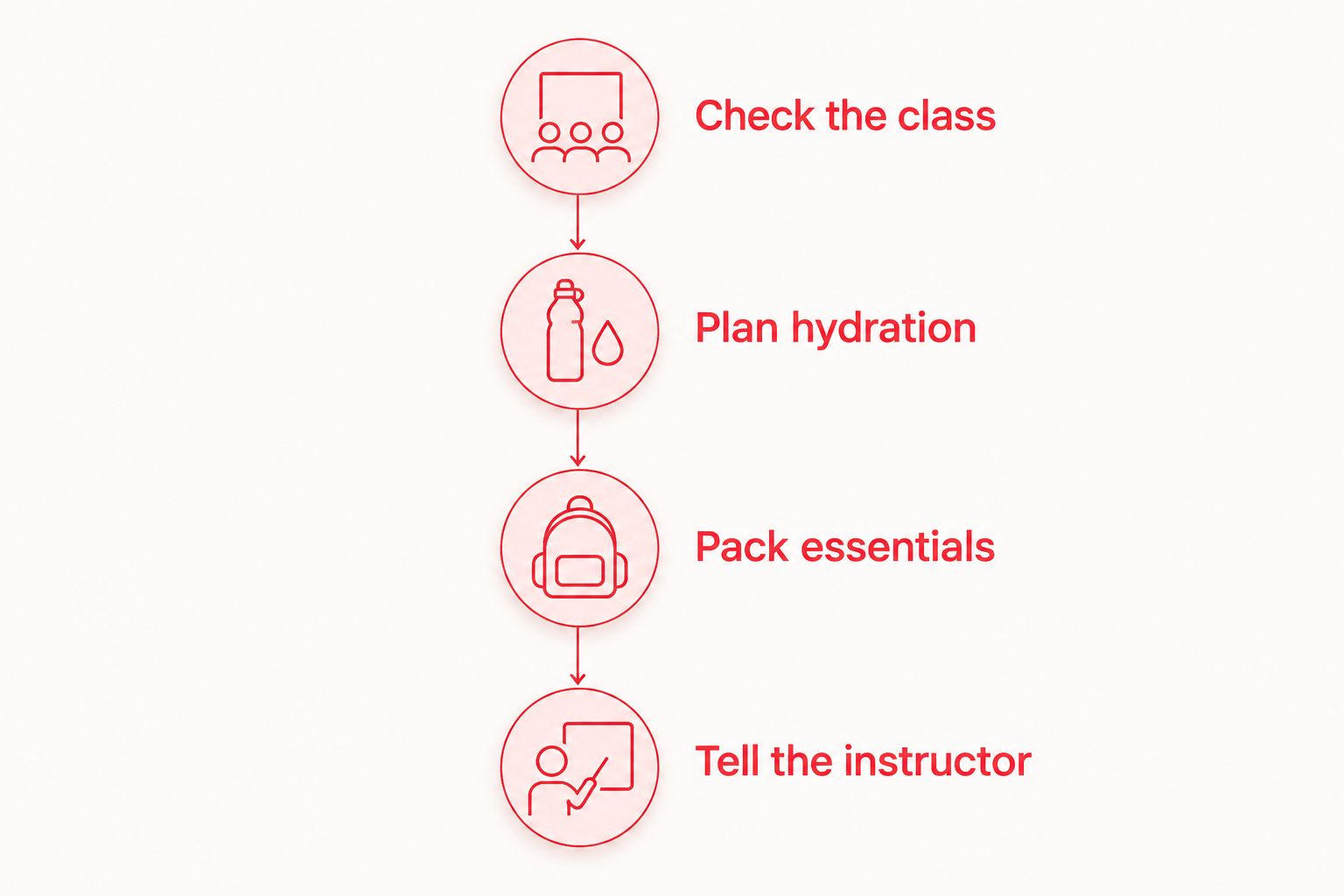
- Check the class. Confirm the format, heat, and beginner guidance. Ask about modifications before arriving rather than guessing from the name.
- Plan hydration. Arrive normally hydrated and bring drinking water. Avoid trying to sweat out extra weight or following an arbitrary drinking target.
- Pack essentials. Consider a mat and towel if the class requires them, and wear clothing that allows comfortable movement. Confirm requirements with the studio.
- Tell the instructor. Explain that you are new and mention relevant restrictions. Ask how to pause or leave the heated room if you feel unwell.
Eat in a way that leaves you comfortable moving; do not arrive deliberately under-fueled to increase weight loss. If you have a medical condition affecting hydration or food intake, follow your clinician's instructions rather than general studio advice.
For a 2026 membership decision, ask Unified Hot Yoga about current class descriptions and newcomer requirements before committing. Then check the studio's current membership information against the classes you realistically expect to attend.
When should you stop or get medical advice?
Dizziness, faintness, nausea, headache, or unusual weakness are reasons to stop exercising in the heat—not signs of a better workout. Move to a cooler place and seek help. Confusion, collapse, or suspected heat stroke requires emergency medical attention.
Speak with a healthcare professional before heated exercise if you are pregnant, have a condition that affects heat tolerance, or take medication that affects sweating or fluid balance. This is especially important when you have previously felt unwell during exercise in the heat.
A welcoming class should leave room for sensible decisions. Taking a break is not failing the practice, and finishing every movement is not more important than responding to symptoms.
FAQ
Can hot yoga help you lose weight without changing what you eat?
Hot yoga can contribute activity, but weight loss still depends on your overall energy balance. Adding classes does not guarantee that your existing eating pattern will produce fat loss.
Is the weight I lose after hot yoga just water?
An immediate drop after a sweaty class largely reflects fluid loss, not a direct measurement of fat loss. Rehydration changes that reading, so avoid judging progress from a post-class weigh-in.
Is hot yoga better than regular yoga for weight loss?
Heat alone does not establish that hot yoga is better for weight loss. Compare the actual movement, your comfort, and the practice you can maintain rather than the amount you sweat.
How often should I do hot yoga to lose weight?
There is no class frequency that guarantees weight loss. Build a manageable routine, allow recovery, and consider your total activity and eating patterns rather than copying someone else's schedule.
Can beginners take classes at Unified Hot Yoga?
Unified Hot Yoga offers classes for practitioners of all skill levels. Confirm the specific session's format and beginner guidance, and tell the instructor that it is your first visit.
Should I choose Hot Pilates or hot yoga for weight loss?
Choose Hot Pilates or hot yoga according to the movement you enjoy and can practice consistently, not a promised weight-loss result. Both require you to consider class demands separately from heat tolerance.
Should I drink less water before hot yoga to weigh less afterward?
No—restricting water to lower your post-class weight encourages dehydration rather than fat loss. Arrive normally hydrated, bring water, and follow medical advice if you have individual fluid restrictions.
One last thing
The most useful first-class goal is not a lower number on the scale. Choose a session you can finish safely and honestly want to attend again. That gives you something practical to build on: a repeatable activity, a clearer sense of your preferences, and a place in a community without a promised body outcome.