Yes, hot yoga can build muscle strength when its poses challenge your muscles, particularly if you are new to exercise; the movements and holds provide that challenge, not the heat itself. It also develops muscular endurance, but gaining substantial muscle size or continuing to increase maximum strength usually requires progressively greater resistance beyond what a yoga class provides.
- Does hot yoga build muscle strength? Yes: challenging poses provide resistance; heat itself does not.
- Vinyasa and 26&2 offer weight-bearing practice; Yin emphasizes longer, more passive holds rather than strength training.
- Progressive resistance training is the more direct choice for substantial muscle growth and maximum strength.
- Unified Hot Yoga suits American Fork beginners who want hot yoga and Pilates class options.
Does hot yoga build muscle strength?
Hot yoga builds strength when supporting your body weight gives your muscles a meaningful challenge. Holding a standing posture or controlling a transition requires muscular effort, even without external weights. Getting hotter does not make that resistance greater.
For your first class in 2026, choose the movement style before choosing the heat level. The class schedule is your starting point for checking the available sessions; ask the studio about the movements, pace, and beginner modifications before booking.
The comparison below describes general class formats, not a promise about the exercises included in a particular session.
| Class format | Best for | Strength-related benefit | Main limitation |
|---|---|---|---|
| Vinyasa | People who enjoy flowing between poses | Weight-bearing poses and controlled transitions challenge muscular strength and endurance | Sequences vary, so resistance is harder to measure consistently |
| 26&2 yoga | People who prefer a set posture sequence | Standing holds challenge leg strength, balance, and postural control | A repeated sequence does not automatically provide progressively greater resistance |
| Yin yoga | People seeking slower, sustained stretching | Holding position requires some postural control | Passive stretching is not a substitute for strength training |
| Hot Pilates | People who enjoy mat-based muscular work | Controlled repetitions challenge muscular endurance and trunk control | Heat and fatigue do not establish how much resistance you used |
| Barre | People who enjoy small, controlled movements | Repeated movements and holds challenge muscular endurance | A burning sensation does not measure maximum-strength development |
| Reformer Pilates | People who prefer equipment-based movement | Spring resistance can challenge muscles through controlled movement | Spring settings also provide assistance in some exercises; harder is not simply heavier |
Why this matters
If you choose a class because you want to feel stronger, you need to distinguish strength from exhaustion. A demanding heated session can leave you tired without providing the same training stimulus as lifting progressively heavier weights.
That distinction helps you set a useful goal. Holding a posture with better control is progress; so is choosing a modification that lets you move without pain. Neither requires finishing completely depleted.
For your 2026 routine, decide whether you mainly want better movement control, more muscular endurance, greater maximum strength, or more muscle size. These goals overlap, but they do not call for identical training.
What kind of strength does hot yoga develop?
Muscular strength: supporting your body weight
Muscular strength is your ability to produce force. In yoga, your muscles produce force to support your body against gravity, stabilize your joints, and control changes in position.
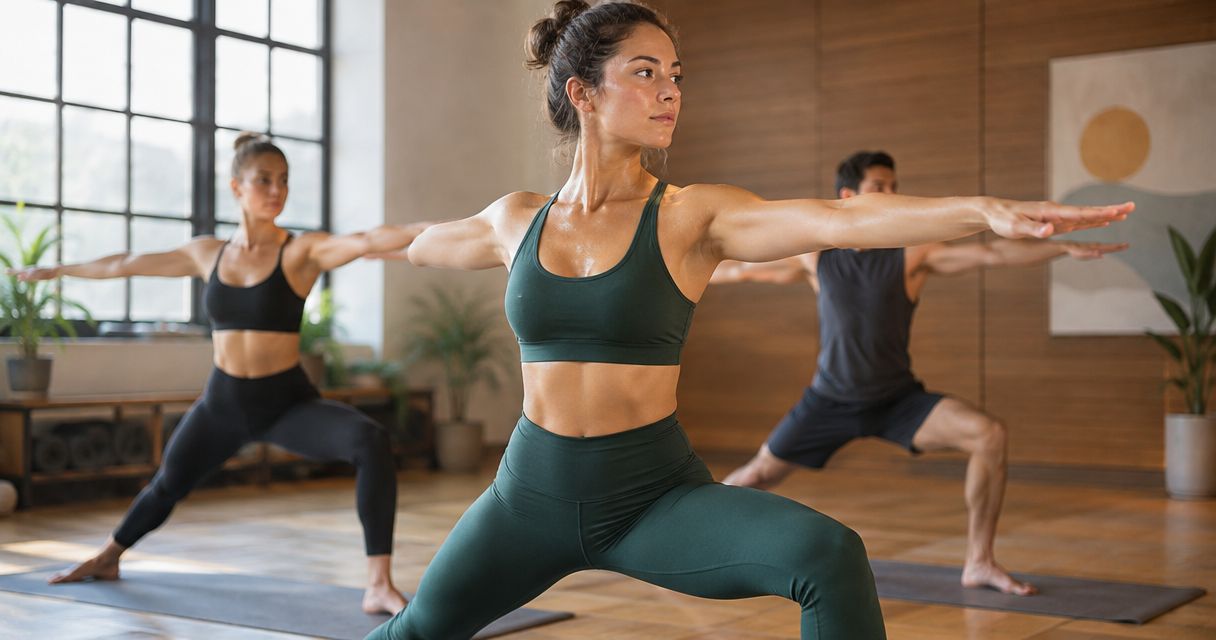
A plank challenges your shoulders and trunk; a standing lunge challenges your legs. Whether either builds strength depends on how demanding the position is for you. A pose that challenges a newcomer might serve mainly as maintenance for someone with extensive strength-training experience.
Muscular endurance: sustaining the effort
Muscular endurance is your ability to sustain or repeat muscular work. Holding a posture or moving through repeated transitions often trains this quality alongside strength.
You might notice that your alignment stays steadier near the end of a class or that you need fewer breaks during familiar movements. Those are useful improvements, but they do not necessarily mean you can produce substantially more force.
Muscle growth: a different training goal
Hot yoga can challenge muscles without being the most direct route to larger muscles. Muscle growth depends on adequate training stimulus, recovery, and nutrition; sweating is not evidence that growth is occurring.
If muscle size is your priority, use a progressive resistance program as the foundation. Keep yoga for the movement practice you enjoy rather than asking it to deliver every training outcome.
Why strength results from hot yoga vary
Your response depends on the work your muscles perform and how that work changes over time. Heat tolerance alone does not explain strength development.
- Starting strength: A body-weight posture presents a different challenge to a beginner than to an experienced lifter.
- Class format: Flowing sequences, standing holds, and passive stretching place different demands on your muscles.
- Exercise difficulty: Leverage, body position, and supported weight influence the resistance you experience.
- Progression: Repeating a familiar challenge indefinitely does not provide an ever-increasing strength stimulus.
- Consistency: A practice you can attend regularly gives you opportunities to learn and repeat movements.
- Recovery: Sleep, nutrition, and time between demanding sessions support adaptation; constant fatigue is not a training target.
These factors also explain why copying another person's class routine does not guarantee the same outcome. Choose a manageable starting point, then assess your own control and recovery.
Does a hotter room build more muscle?
A hotter room does not replace greater muscular resistance. Heat increases the body's cooling demands and can make exercise feel more difficult, but perceived difficulty and muscle-loading difficulty are not the same thing.
Infrared heating describes how heat is delivered, not how much force your muscles produce. Do not use sweat volume, a flushed face, or the highest tolerable temperature as a strength score.
In 2026, use the same practical rule you would use outside a heated room: choose a challenge that lets you maintain control and breathe comfortably. If you feel dizzy, faint, or nauseated, stop exercising and move to a cooler place; seek medical help for severe or persistent symptoms.
Which class should a beginner choose for strength?
Choose the format whose movements you want to learn, then ask how the instructor adapts them for newcomers. Beginner suitability depends on instruction, exercise choices, and your health history—not just the class name.
Vinyasa is worth considering if you enjoy moving between postures. Ask about the pace and options for weight-bearing transitions rather than assuming every flow includes the same exercises.
26&2 yoga is worth considering if a consistent posture sequence appeals to you. Balance and standing holds provide a different experience from flowing repeatedly between poses; neither format is automatically easier.
Yin yoga fits a slower stretching goal better than a primary strength goal. You can value that practice without counting it as a replacement for resistance exercise.
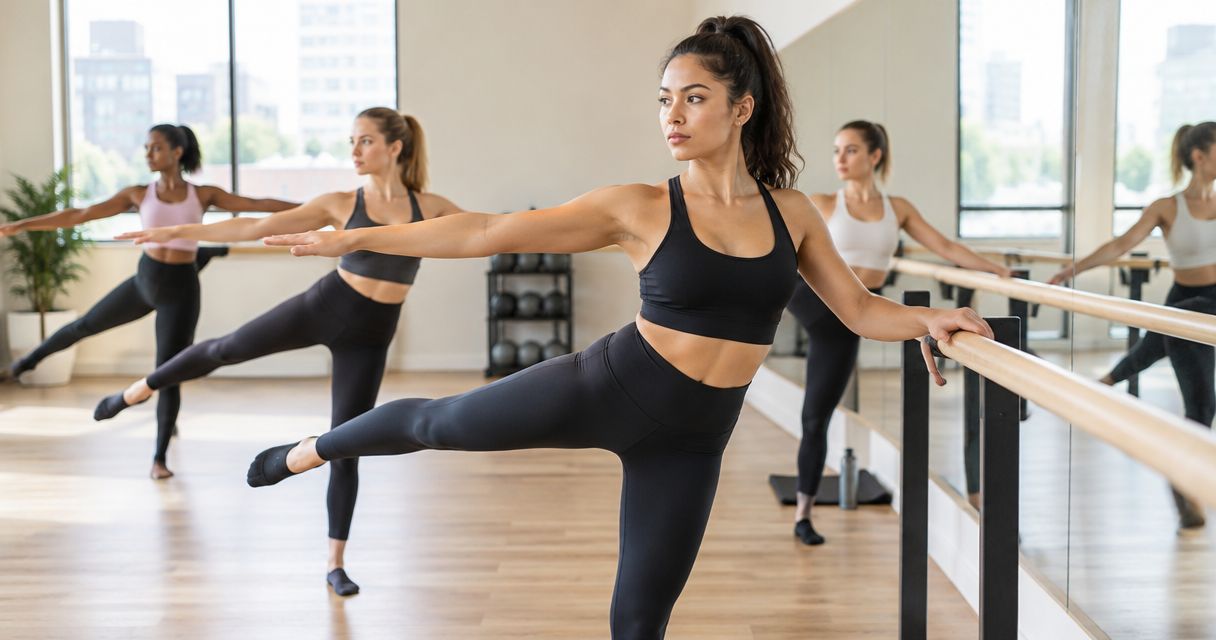
Hot Pilates, Barre, and Reformer Pilates deserve equal consideration if you prefer focused muscular work to yoga postures. Ask about the actual class structure and available modifications; a class label alone does not establish its difficulty.
Unified Hot Yoga offers these class categories for practitioners of all skill levels in American Fork. Its range gives you options to discuss with the studio, not a reason to assume every session fits every beginner equally.
How can you make a first class useful for strength?
Start with a learning goal rather than a performance target. Your first session should help you understand the instruction, identify suitable modifications, and judge how you respond to the environment.
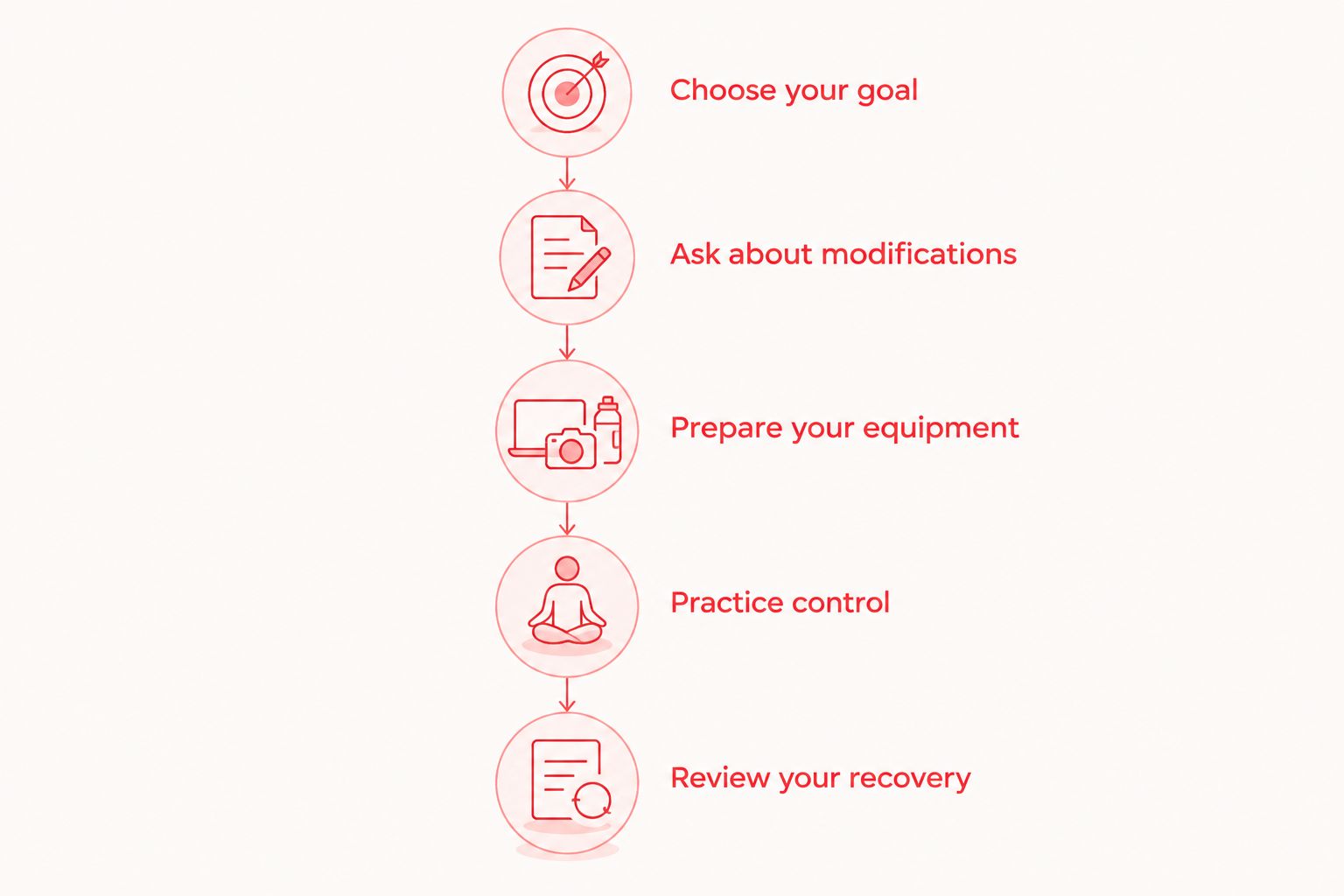
- Choose your goal. Decide whether you want to practice weight-bearing poses, controlled repetitions, or slower stretching.
- Ask about modifications. Tell the instructor you are new and mention relevant injuries or movement restrictions before class.
- Prepare your equipment. Ask what the studio supplies; confirm mat, towel, water, footwear, and grip-sock requirements for your chosen format.
- Practice control. Use the version of each movement that lets you maintain alignment without sharp pain or breath-holding.
- Review your recovery. Notice how you feel afterward and before your next demanding session, rather than judging success by soreness.
Wear clothing that allows movement, arrive hydrated, and avoid treating the heated room as an endurance contest. Bring questions, too. Asking for a modification is part of learning, not a sign that you chose the wrong activity.
If pregnancy, a cardiovascular condition, medication, or another health concern affects your heat tolerance, ask your healthcare professional about heated exercise before participating. General beginner guidance does not replace individual medical advice.
How often should you practice if strength is your goal?
For your 2026 exercise plan, the U.S. Department of Health and Human Services' Physical Activity Guidelines for Americans recommend muscle-strengthening activity on at least 2 days per week for adults, involving all major muscle groups. A yoga class contributes when its movements provide sufficient muscular challenge; the label alone does not establish that it covers every muscle group.
The same guidelines recommend 150 minutes per week of moderate-intensity aerobic activity or 75 minutes per week of vigorous-intensity activity, or an equivalent combination. Those are aerobic targets, not suggested hot-yoga class lengths, and a heated class does not automatically qualify as vigorous aerobic exercise.
Build your attendance around recovery and the rest of your training. The guide to how many times a week to do hot yoga addresses the scheduling question separately from choosing a strength-focused format.
Can hot yoga replace lifting weights?
Hot yoga can provide meaningful body-weight resistance, especially for beginners, but it does not offer the same straightforward load progression as weights. For maximum strength or substantial muscle growth, progressive resistance training is the more direct choice.
You do not have to choose a single activity for every goal. Combining resistance training with yoga lets each serve a clear purpose, provided the overall workload leaves you able to recover.
How do you know whether you are getting stronger?
Look for improved performance in a comparable movement, not just a more intense sensation. Better control in the same posture, less reliance on an appropriate support, or a carefully progressed variation can indicate improvement.
Compare like with like. A hotter room, a faster sequence, and less rest all change the experience, so they are not clean measures of increased strength.
FAQ
Does hot yoga build muscle strength if I'm a beginner?
Yes, hot yoga can build muscle strength when supporting your body weight challenges your muscles. Start with manageable variations and prioritize controlled movement rather than tolerating more heat.
Will hot yoga make my muscles bigger?
Hot yoga is not the most direct approach to substantial muscle growth. Progressive resistance training provides a clearer way to increase muscular loading over time.
Is sweating more a sign that I'm building more strength?
No, sweating more is not a measure of strength development. Sweat helps regulate body temperature; muscular resistance and training progression determine the strength challenge.
Is Yin yoga a strength workout?
Yin yoga is not a substitute for a strength workout. Its emphasis on sustained, relatively passive stretching differs from progressively challenging muscles against resistance.
Should I do hot yoga every day to get stronger?
Daily hot yoga is not required to get stronger. Balance challenging sessions with recovery and consider whether your overall routine includes sufficient resistance work for all major muscle groups.
What should I bring to my first hot yoga class?
Plan for water, suitable exercise clothing, a mat, and a towel, and confirm what the studio provides before attending. Ask separately about equipment and footwear requirements if you choose Pilates or Barre.
Does Unified Hot Yoga offer alternatives to hot yoga?
Unified Hot Yoga offers Hot Pilates, Reformer Pilates, and Barre alongside Vinyasa, Yin, and 26&2 yoga. Ask about the movements and beginner modifications in the class you are considering.
One last thing
Feeling less exhausted can be a sign of progress, not a reason to chase more heat. When a familiar posture becomes easier, discuss a controlled progression with your instructor instead of assuming a hotter session will build more strength.
For your next class in 2026, choose one movement-quality goal: steadier balance, a controlled transition, or a modification you can repeat comfortably. At Unified Hot Yoga, make that goal part of your conversation before class so the session supports your wellbeing rather than becoming a test of tolerance.