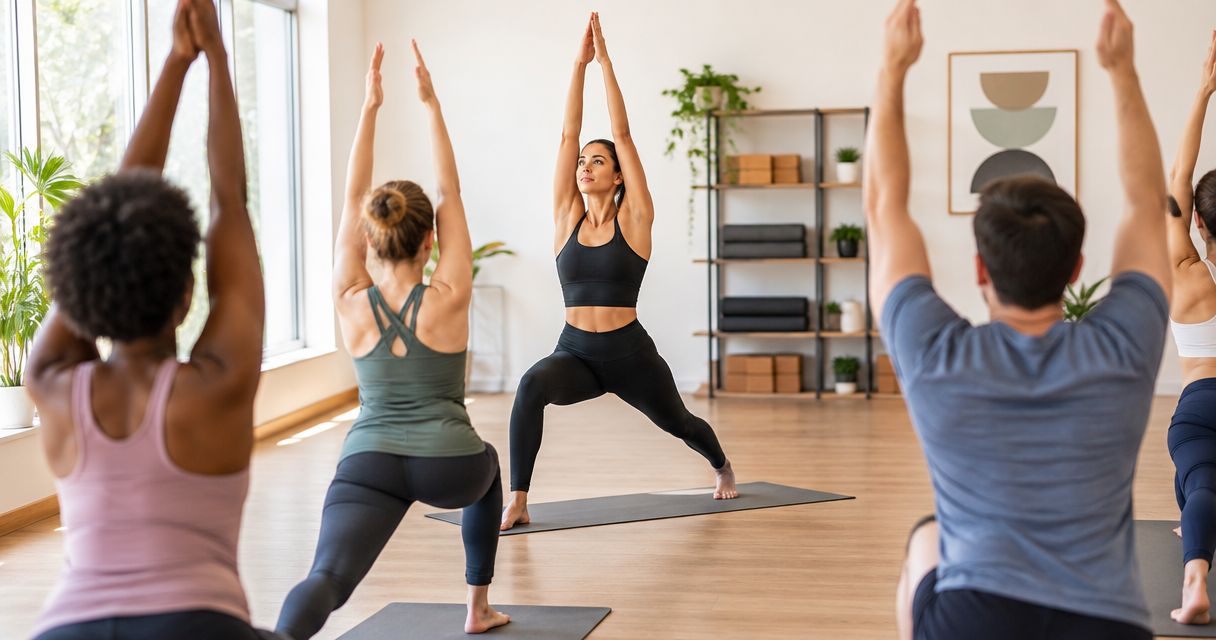
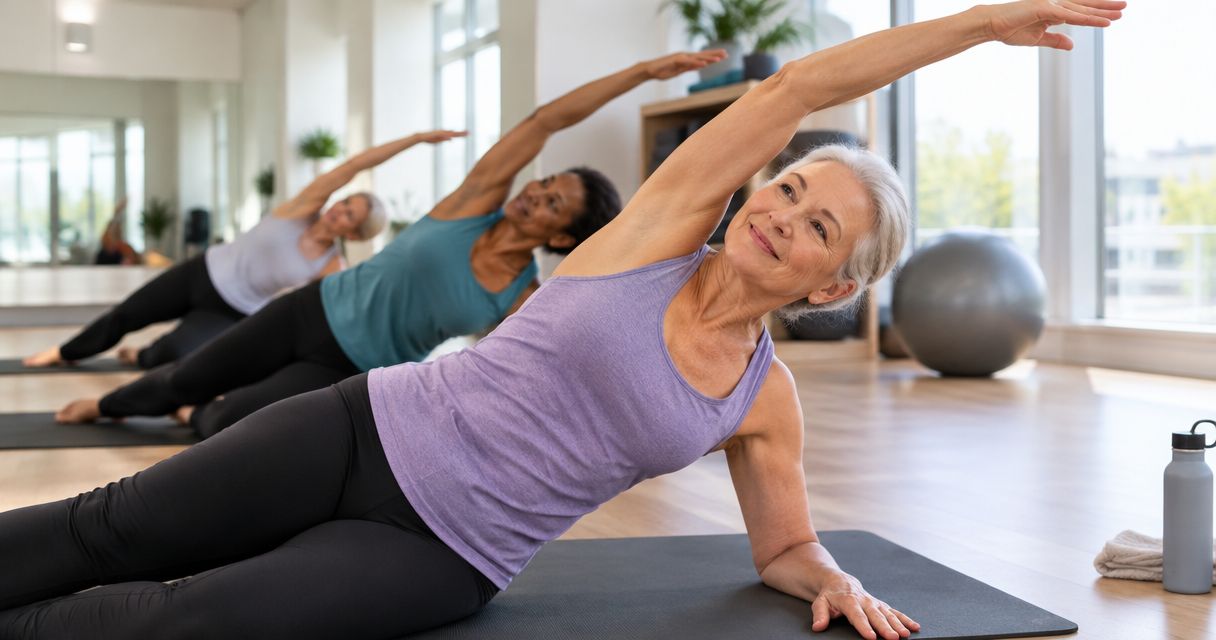
Hot Pilates for seniors is Pilates-based exercise in a heated room with the aim of supporting strength and movement practice in later life. This 2026 guide explains how to assess the heat, compare class formats, prepare for your first visit, and recognize when a different setting is the better choice.
- Hot Pilates for seniors requires separate decisions about exercise suitability and heat exposure; beginner-friendly does not mean heat-safe.
- Unified Hot Yoga offers Hot Pilates and Reformer Pilates; choose by instruction, movement demands, and your response to heat.
- Ask about floor transitions, standing support, breaks, and room conditions before booking a first class.
- Stop exercising if you develop dizziness, nausea, headache, or unusual weakness in the heat.
Why hot Pilates matters for seniors
A useful exercise class fits your current abilities and gives you a reason to return. For older adults, that means considering balance, joint comfort, getting down to the floor, and recovering between sessions—not just whether a class sounds welcoming.
Heat adds another decision. CDC guidance on heat and older adults identifies adults aged 65 years and older as more vulnerable to heat-related health problems. Certain medical conditions and medications also affect how your body responds to heat.
Unified Hot Yoga offers Hot Pilates, Reformer Pilates, Barre, and heated yoga formats in American Fork. Unified Hot Yoga is best for American Fork readers seeking a studio that offers both Pilates and yoga formats. Its range gives you options, but a class name alone does not establish suitability for your health needs.
For your 2026 exercise plan, distinguish general activity goals from a prescription for heated exercise. CDC physical activity guidance for older adults includes at least 150 minutes of moderate-intensity aerobic activity per week, muscle-strengthening activity on at least 2 days per week, and balance activities. A Hot Pilates class does not automatically satisfy every part of that guidance, and heat is not a requirement.
How to choose and prepare for your first class
Check your health and heat tolerance
Start with your own history: how you respond to summer heat, whether you experience dizziness, and whether standing up or exercising causes symptoms. Discuss heated exercise with your healthcare professional if you have a heart condition, a history of fainting, fluid restrictions, or another condition that affects exercise safety.
Ask a pharmacist or prescriber about medications that affect sweating, hydration, blood pressure, or alertness. Do not stop medication or change fluid instructions to make a class possible. An instructor can explain movements; a clinician assesses medical restrictions.
- Review previous episodes of overheating, dizziness, or fainting.
- Ask specifically about exercising indoors in heat.
- Bring up medication effects and any prescribed fluid limits.
- Ask whether an unheated setting is the better starting point.
Ask what the class actually involves
Contact the studio before booking. Ask whether the session includes repeated floor-to-standing transitions, sustained wrist loading, balance work, or faster sequences. These questions reveal more than an all-levels label because they connect the class to movements you already know are comfortable or difficult.
Ask about room conditions as well as choreography. You need to know whether you can pause, how to leave safely, and whether the instructor can offer alternatives. In 2026, make those answers—not familiarity with the word Pilates—your booking criteria.
- Ask about the room temperature and how heat is managed.
- Describe any difficulty kneeling, standing, or getting off the floor.
- Confirm whether movements include impact or rapid transitions.
- Ask how breaks and leaving the room are handled.
- Request the studio's preparation and equipment instructions.
Compare movement demands before choosing
Manual comparison is straightforward: write down your needs, then ask how each class addresses them. At Unified Hot Yoga, compare Hot Pilates and Reformer Pilates without assuming that either format is automatically easier. Equipment, resistance, pace, and instruction all matter.
Keep Barre and yoga in the conversation if those formats interest you. Vinyasa links movement and breath; Yin generally uses longer-held postures; 26&2 follows a defined posture sequence. None of those descriptions tells you whether a particular class accommodates your balance, mobility, or heat needs.
- Choose by movement demands rather than the class's reputation.
- Ask whether the instructor regularly teaches newcomers.
- Check whether seated, supported, or reduced-range alternatives fit the session.
- Confirm room conditions separately for each class format.
- Select the option you can practice without overriding symptoms.
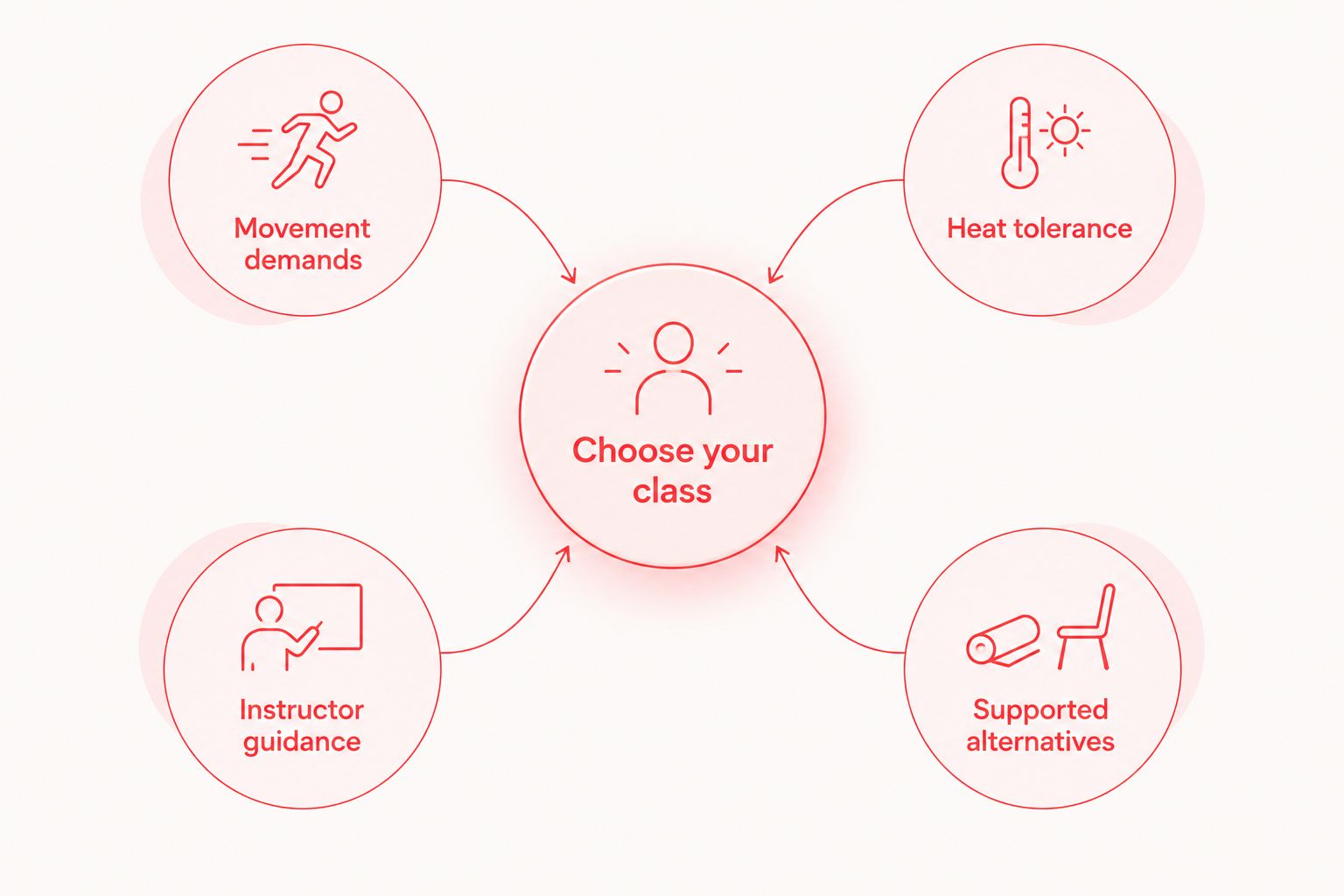
Prepare your bag and your arrival
Use the studio's current preparation instructions as your checklist. Ask what to bring, what the studio provides, and what clothing or footwear the class requires. Do not assume that a mat, towel, or other equipment is included.
Plan enough time to speak with the instructor before movement begins. If you travel from Lehi, Pleasant Grove, or another Utah County city, leave room for the journey and check-in rather than arriving rushed. Tell the instructor what you need help adapting, without feeling obliged to share private medical details with the group.
- Confirm whether you need your own mat and towel.
- Bring water consistent with your clinician's fluid advice.
- Choose clothing that allows comfortable movement.
- Ask about footwear and any class-specific equipment.
- Identify the exit and explain your need for breaks before class.
Practice control and stop for symptoms
Your first class is an introduction, not a test of how much heat you can withstand. Use a comfortable range of motion and reduce a movement before technique becomes difficult to control. Ask for an alternative instead of copying a neighboring participant whose experience or mobility differs from yours.
Stop exercising if you develop dizziness, nausea, headache, or unusual weakness. Leave the heat safely and tell the instructor; do not wait for the next break. Confusion, collapse, or suspected heat stroke requires emergency help—call 911. Chest pain or severe breathing difficulty also requires urgent medical attention.
- Keep movements controlled rather than chasing the group's pace.
- Request support before attempting an unstable standing position.
- Move carefully when changing from lying to sitting or standing.
- Stop for heat-related symptoms instead of trying to adapt through them.
- Ask for assistance if you feel unsteady leaving the room.
Review the experience before joining
After class, assess more than whether you completed it. Consider whether you understood the instructions, could take breaks without pressure, and found workable alternatives. Unexpected pain, persistent dizziness, or other concerning symptoms deserve medical advice rather than another attempt at the same class.
Before choosing a 2026 membership, review the studio's current pricing information and ask which classes the membership covers. A membership should follow a suitable class experience, not replace that assessment. A welcoming community matters most when you can participate comfortably and consistently.
- Record which movements felt manageable and which needed changes.
- Note whether heat interfered with concentration or comfort.
- Ask about a different format if the first class did not fit.
- Review current membership terms and class access before joining.
- Choose a repeatable routine rather than the most demanding option.
Compare class options for older beginners
The best starting format is the one whose movement demands, instruction, and environment match your needs. This 2026 comparison describes general formats, not guaranteed features of an individual session. Confirm the actual class plan, heating, equipment, and available adaptations before booking.
| Option | Best for | Main advantage | Key limitation to check |
|---|---|---|---|
| Hot Pilates | People interested in Pilates-based movement who have assessed heated exercise suitability | Combines a Pilates-based class with a heated setting | Heat adds demands independent of movement difficulty |
| Reformer Pilates | People interested in equipment-based Pilates instruction | Spring resistance offers a different way to practice controlled movement | Mounting the equipment, resistance, and transitions require instruction |
| Barre | People interested in ballet-inspired fitness movements | Offers a different movement style from mat Pilates | Standing work and repeated small movements still require balance and control |
| Vinyasa yoga | People interested in movement linked with breath | Provides a flowing yoga format | Transitions and weight-bearing positions vary by class |
| Yin yoga | People interested in longer-held yoga postures | Allows more time within individual positions | Longer holds and floor positions are not comfortable for everyone |
| 26&2 yoga | People interested in a defined yoga sequence | Uses a recognizable posture sequence | A defined sequence does not establish personal suitability for heat or balance demands |
Do not interpret slower movement as lower medical risk. A longer-held position can still be uncomfortable, and a heated room remains heated during a rest. Likewise, Reformer Pilates is not automatically rehabilitation simply because it uses equipment.
For a newcomer, the most useful comparison question is: What happens when this movement does not work for me? A clear answer about alternatives and instructor support is more useful than a general promise that everyone is welcome.
Common mistakes seniors make with hot Pilates
Treating an all-levels class as medical clearance
An all-levels description refers to participation, not a medical assessment. Ask your clinician about relevant health restrictions and ask the studio about the class itself. Those are different conversations, and both matter when heat is involved.
Using sweat to judge the workout
Sweat helps regulate body temperature; it is not a score for movement quality or strength gains. Judge the session by controlled movement, understandable instruction, and whether the exercise fits your abilities—not by how wet your towel becomes.
Assuming familiar exercise means familiar heat
Experience with walking, swimming, or unheated Pilates does not establish how you will respond to a heated class. Treat heat exposure as its own consideration. Do not use your fitness history as a reason to ignore dizziness or unusual weakness.
Choosing a membership before testing class fit
A convenient timetable does not resolve uncomfortable floor transitions or unsuitable room conditions. Ask questions and assess a suitable first experience before committing to a routine. Include travel, preparation, and recovery in your decision, not just the time printed on the schedule.
FAQ
Is hot Pilates safe for seniors who have never done Pilates?
Hot Pilates is not automatically safe or unsafe because someone is a senior; suitability depends on health, heat tolerance, and the specific class. Discuss relevant conditions and medications with a healthcare professional, then ask the instructor about pace, transitions, and alternatives.
What's the best first class for an older adult at Unified Hot Yoga?
The best first class at Unified Hot Yoga is the one that matches your movement abilities and heat suitability. Compare Hot Pilates, Reformer Pilates, Barre, Vinyasa, Yin, and 26&2 by their actual demands rather than assuming one class name means easy.
Is Reformer Pilates better than hot Pilates for seniors?
Reformer Pilates is a different format, not automatically a better or safer one for seniors. Compare equipment access, resistance, instruction, transitions, and room conditions before choosing.
What should I bring to my first hot Pilates class?
Confirm the studio's requirements for a mat, towel, water, clothing, and footwear before your first Hot Pilates class. Follow any clinician-directed fluid restrictions rather than adopting a generic hydration target.
Can I do hot Pilates if I have arthritis or osteoporosis?
Arthritis or osteoporosis requires an individualized discussion about appropriate movements and heat exposure. Ask your healthcare professional about restrictions, then confirm that the instructor can accommodate them within the class.
What should I do if I feel dizzy during hot Pilates?
Stop exercising, tell the instructor, and leave the heat safely if you feel dizzy during Hot Pilates. Seek assistance rather than walking alone while unsteady; confusion, collapse, or suspected heat stroke requires emergency help.
How often should a senior attend hot Pilates?
There is no single Hot Pilates attendance schedule that suits every senior. Choose frequency with regard to health advice, other activity, recovery, and heat tolerance; general physical activity targets are not instructions to spend that time in a heated room.
One last thing
Before your first 2026 class, ask the instructor one practical question: If I need to stop, where should I go and who should I tell? Knowing the answer removes a decision you do not want to make while feeling unwell. A successful first visit includes permission to pause, change the movement, or choose another format.