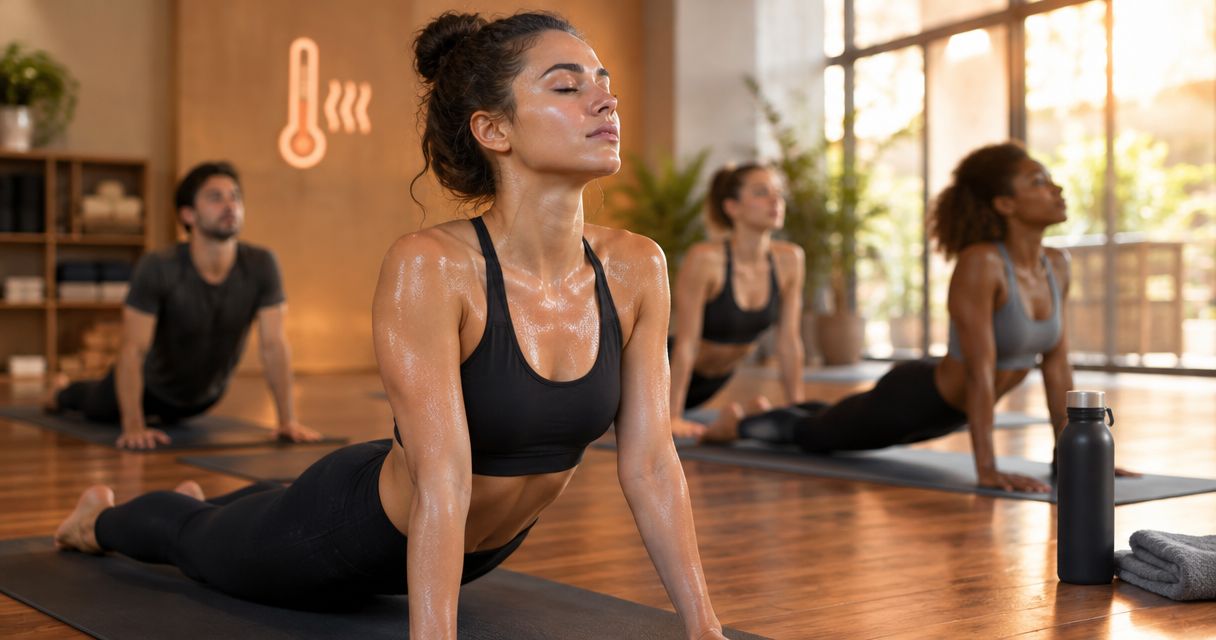
A traditional Bikram-style hot yoga studio is heated to 105°F (about 40°C), but hot yoga has no universal temperature: the setting depends on the class and studio. For your first class in 2026, confirm the room temperature and humidity rather than assuming every heated Vinyasa, Yin, or 26&2 session follows that traditional standard.
- How hot does a hot yoga studio get? Traditional Bikram-style classes use 105°F; other hot yoga settings vary.
- Infrared heating describes how heat reaches you, not a guaranteed room temperature.
- Choose your first class by temperature, movement pace, and permission to take breaks—not heat alone.
Why this matters
The thermostat tells you about the room, not the entire experience. A flowing class adds physical effort to the heat, while a slower class changes the movement demands without removing heat exposure.
For American Fork and nearby Utah County residents choosing a first class in 2026, that distinction matters more than finding the hottest room. Unified Hot Yoga offers infrared-heated yoga alongside Hot Pilates, Barre, and Reformer Pilates; ask about the conditions of the particular class you plan to attend.
Choose a class you can participate in comfortably, not a temperature you feel obliged to tolerate. You belong in the room without matching another person's pace or range of motion.
How hot does a hot yoga studio actually get?
The clearest reference point is the traditional Bikram-style environment: 105°F, approximately 40°C, with 40% relative humidity. These are established conditions for that method, not a temperature promise for every class called hot yoga or every class labeled 26&2.
A class name describes the practice more reliably than it describes the thermostat. Use the comparison below to separate the movement format from the heat question; the descriptions explain general class categories, not a particular studio's lesson plan.
| Class format | What the practice generally involves | Best for | Trade-off and heat question |
|---|---|---|---|
| Vinyasa | Moving between poses with breath | People who enjoy a flowing practice | Pace adds effort; confirm the room setting and beginner options. |
| Yin | Longer-held, mostly floor-based postures | People who prefer less frequent transitions | Stillness does not remove heat exposure; confirm whether the session is heated. |
| 26&2 | A structured sequence of yoga postures and breathing exercises | People who like a repeating format | Repetition does not guarantee an easy class; ask whether traditional heat conditions apply. |
| Hot Pilates | Pilates-based exercise in a heated environment | People seeking a heated, exercise-focused class | Heat and muscular effort combine; ask about intensity and modifications. |
| Barre | Exercises drawing on ballet-inspired positions and strength work | People who enjoy controlled, repeated movements | Small movements can still be demanding; verify whether the class is heated. |
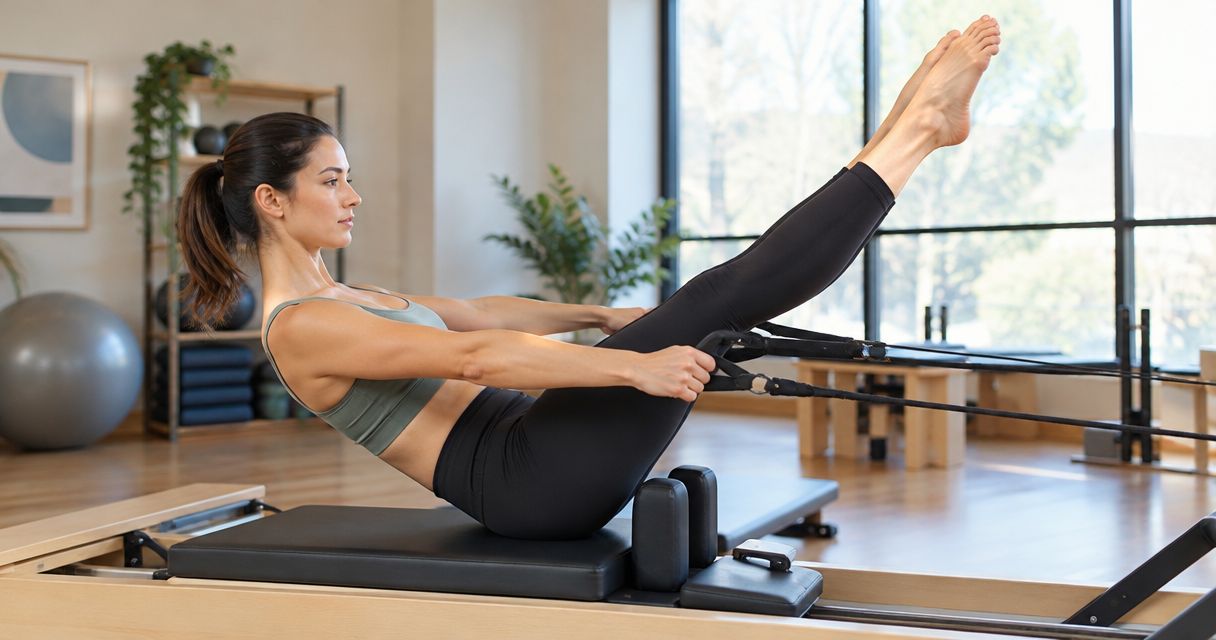
| Reformer Pilates | Pilates exercises using a spring-resistance apparatus | People interested in equipment-based movement | Equipment introduces a learning step; confirm beginner instruction and room conditions. |
None of these formats wins for every newcomer. Start with the movement style you want, then check whether its heat level fits you. A familiar exercise format in an unfamiliar temperature still deserves preparation.
Traditional Bikram-style heat: 105°F and 40% humidity
Traditional Bikram-style practice uses a deliberately hot, humid environment. The commonly published standard is 105°F with 40% relative humidity; that combination is more informative than the temperature alone.
Humidity matters because sweat cools you when it evaporates. More moisture in the air limits evaporation, so two rooms with the same thermometer reading can feel different.
Do not treat the traditional standard as a beginner target. You do not need to complete a class at 105°F to prove that you are ready for yoga, and a cooler class is not a lesser practice.
Before booking a 26&2 class, ask whether the studio follows those traditional environmental conditions. The sequence name alone does not establish the room temperature, humidity, class duration, or teaching approach.
Infrared heating does not specify a temperature
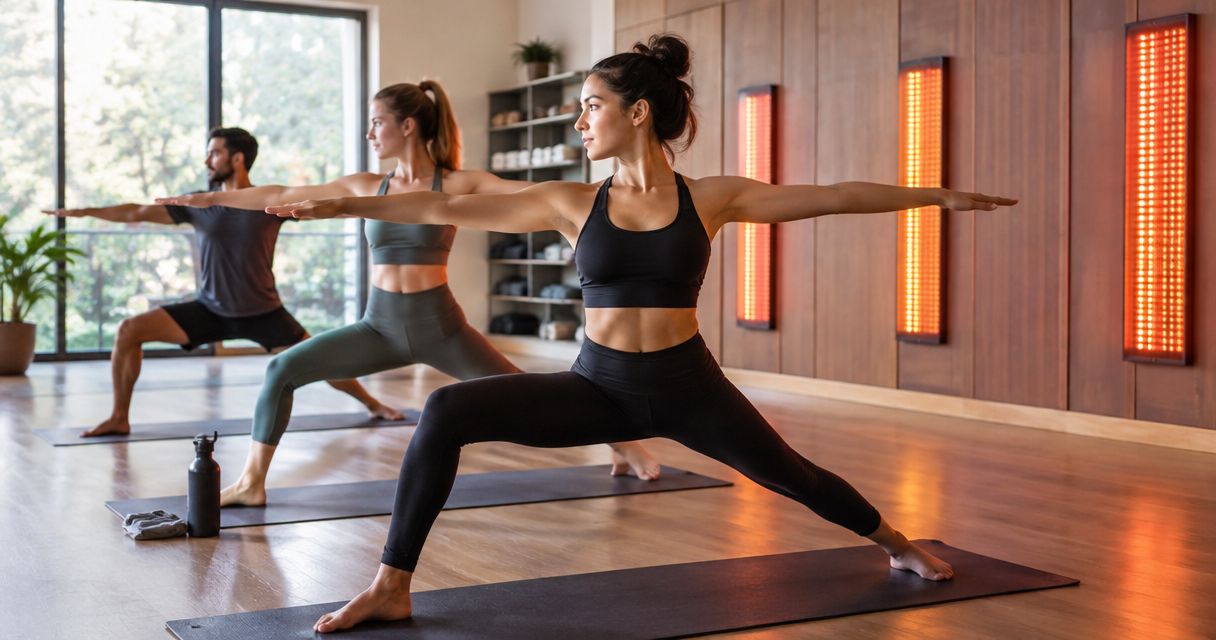
Infrared heating transfers energy through radiant heat. A conventional heating system primarily warms circulating air; the distinction describes heat delivery, not a universal thermostat setting.
An infrared-heated room still exposes you to heat. Infrared is not a substitute for checking temperature, humidity, and your own response. Do not interpret the heating method as a guarantee that a class will feel gentler or suit a medical condition.
When comparing class descriptions in 2026, separate the heating system from the practice. Ask what the room is set to, which class uses that setting, and how newcomers should handle breaks.
Avoid choosing by claims about sweating more or enduring longer. Your useful comparison is whether the class gives you a movement experience you want under conditions you can manage.
Why hot yoga feels different from class to class
Room temperature is only part of heat exposure. These factors explain why a single number cannot predict your whole experience:
- Humidity: Moist air reduces the evaporation of sweat, affecting how effectively your body releases heat.
- Movement pace: Frequent transitions and sustained muscular work generate additional body heat.
- Heating method: Radiant heat and heated circulating air deliver warmth differently, even when descriptions use the same word: hot.
- Air movement: Airflow affects evaporation and how warm the room feels against your skin.
- Exposure time: Spending longer in a heated environment extends the time your body must manage that heat.
- Your condition that day: Illness, dehydration, medications, and unfamiliarity with heat can affect your tolerance.
Treat these as questions to understand, not variables you must calculate. A useful class description explains the format and environment; a useful conversation with the instructor clarifies what to do if either feels overwhelming.
Your experience also belongs to you. Another student's comfort does not establish that the same conditions are appropriate for your body.
How should you prepare for your first heated class?
Prepare for both movement and heat. Bring what helps you practice securely, and confirm studio requirements rather than assuming equipment, towels, or other items are provided.
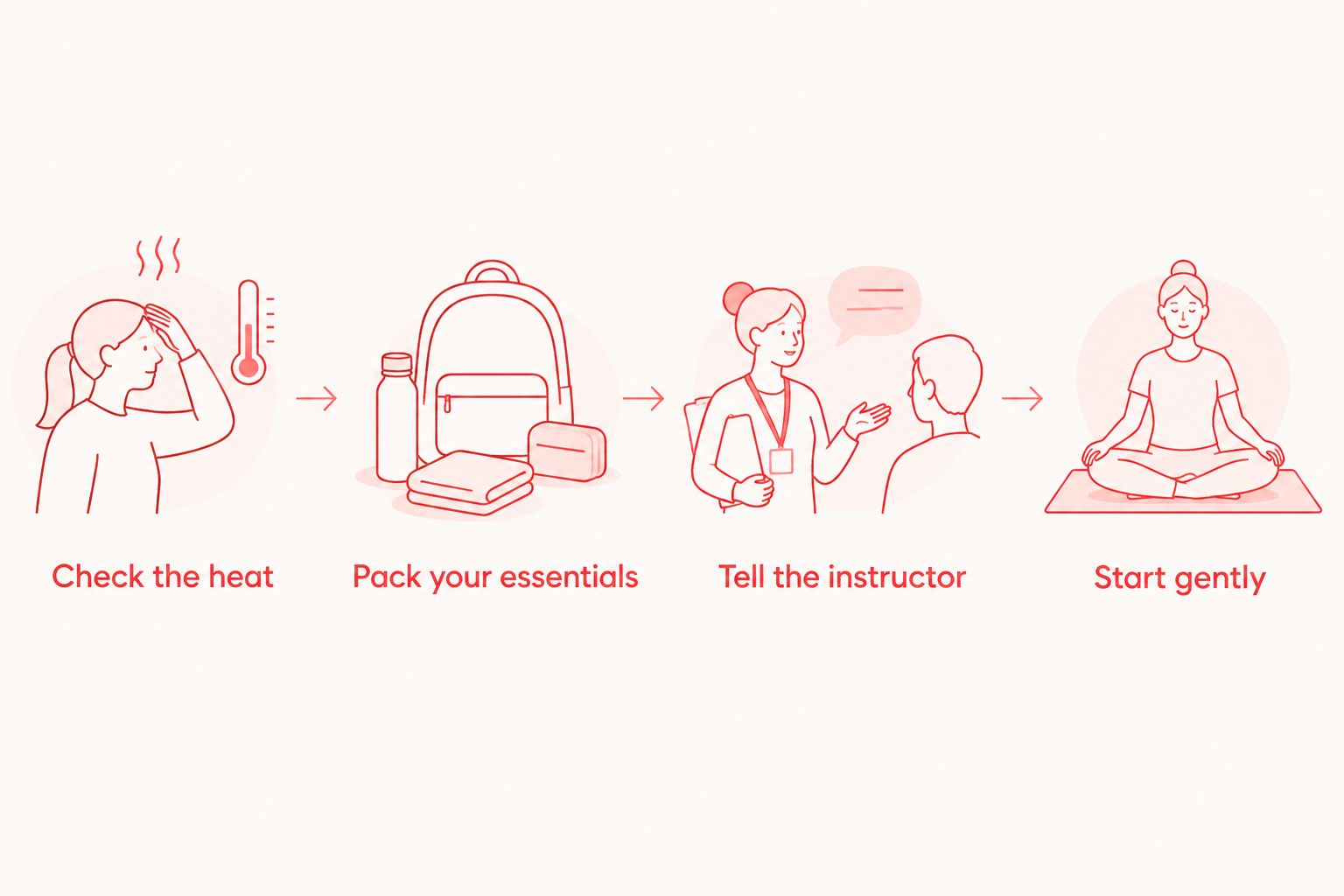
- Check the heat. Ask for the temperature and whether humidity is controlled. Confirm that the answer applies to your specific class, not just the studio's hottest offering.
- Pack your essentials. Plan for breathable clothing, water, a yoga mat for a mat-based class, and a towel for sweat. Check footwear and equipment requirements for the format you choose.
- Tell the instructor. Say that you are new to heated exercise and ask how to modify movements, take a break, and leave the room safely.
- Start gently. Choose a manageable effort and range of motion. Heat is not a reason to push farther into a stretch or ignore discomfort.
Drink water regularly before class rather than trying to catch up immediately before it starts. There is no single drinking amount that fits everyone; your needs depend on your body, activity, environment, and any medical guidance you follow.
Use the first hot yoga class packing guide to organize your bag. Confirm rental or borrowing arrangements directly before relying on them.
Which class should a beginner choose?
Choose a class by its teaching support, movement demands, and verified heat conditions. Do not select Yin solely because it looks still, or rule out Vinyasa solely because it involves flowing movement.
Unified Hot Yoga is a fit for American Fork beginners who want yoga, Pilates, and Barre options at one studio. Its all-skill-levels offering gives you several formats to consider; the remaining decision is which specific class matches your experience and comfort with heat.
For a first visit in 2026, describe what you actually want: flowing yoga, a repeated sequence, longer-held postures, Pilates-based exercise, ballet-inspired movement, or spring-resistance equipment. Then ask which session provides appropriate beginner instruction.
The practical limitation is that a broad class menu does not tell you each room setting or each instructor's pace. Verify those details before choosing, and review current membership information only after you know which classes you want to attend.
Is 105°F too hot for a beginner?
105°F is not a temperature every beginner should attempt. Your health, experience with heated exercise, and ability to reduce effort all matter; the class label cannot establish whether that exposure is appropriate for you.
Start with the environment you can manage rather than a traditional benchmark. If you have a health condition or take medication that affects heat tolerance, ask your clinician before heated exercise.
Does 40% humidity make hot yoga feel hotter?
40% relative humidity is part of the traditional Bikram-style standard, and humidity affects how sweat evaporates. At the same air temperature, increased humidity generally makes it harder for your body to cool through evaporation.
That is why asking only for the thermostat setting leaves out useful information. Ask about humidity as well, especially when comparing a traditional hot yoga class with another heated format.
When should you stop or leave the heated room?
Stop exercising if you become dizzy, nauseated, unusually weak, or develop a headache in the heat. Tell the instructor, move to a cooler place safely, and seek help rather than trying to finish the sequence.
Confusion, collapse, or loss of consciousness is an emergency. Get emergency medical help immediately; do not assume the person simply needs motivation or a longer rest on the mat.
A resting posture reduces physical effort but does not remove the room's heat. If heat is the problem, remaining in the heated space is not the same as cooling down.
Pregnancy also changes the decision. The American College of Obstetricians and Gynecologists advises avoiding hot yoga and hot Pilates during pregnancy because of overheating risk; discuss suitable alternatives with your prenatal clinician.
FAQ
How hot does a hot yoga studio get?
Traditional Bikram-style hot yoga uses 105°F, approximately 40°C, with 40% relative humidity. Other heated yoga classes use different settings, so confirm the conditions for your specific session.
Is every 26&2 yoga class heated to 105°F?
No, the 26&2 label alone does not confirm a room temperature. Ask whether the studio uses the traditional Bikram-style heat and humidity conditions for that class.
Is infrared hot yoga cooler than regular hot yoga?
Infrared heating does not establish whether a class is cooler. It describes radiant heat delivery; compare the actual room temperature, humidity, and movement demands.
Can I take breaks during my first hot yoga class?
Plan to reduce effort when needed and ask the instructor how to take breaks safely. If you develop symptoms of overheating, stop and move to a cooler place rather than relying only on a resting posture.
What should I bring to a heated yoga class?
Bring breathable clothing, water, a yoga mat, and a towel, then confirm the studio's specific requirements. Do not assume rentals, loan equipment, or towels are included.
Are Barre and Reformer Pilates always heated?
No, neither Barre nor Reformer Pilates specifies a heated environment. Ask about the room conditions and beginner instruction for the particular session you intend to book.
Does Unified Hot Yoga offer options besides hot yoga?
Unified Hot Yoga offers Hot Pilates, Barre, and Reformer Pilates alongside Vinyasa, Yin, and 26&2 yoga. Confirm the heat setting and class expectations for each format before choosing your first visit.
One last thing
Sweat is a cooling response, not a score for your workout. More sweat does not establish better technique, greater flexibility, or a more suitable class.
For your first heated session in 2026, make the goal simple: learn the room, understand the instructions, and notice how you respond. A class you can approach with confidence and repeat comfortably is a better starting point than a temperature you merely endure.