There is no universal number of weeks or classes it takes to master Reformer Pilates form: judge progress by whether you can repeat an exercise with controlled movement, steady breathing, and less correction. Learning the equipment is only the beginning; maintaining those skills when the movement changes is a separate part of the process.
- For how long to master reformer pilates, use movement checkpoints rather than a promised deadline.
- Reformer Pilates progress means controlling the carriage, following the intended alignment, and applying your instructor’s feedback.
- Unified Hot Yoga offers Reformer Pilates for practitioners of all skill levels in American Fork.
- Choose a manageable movement before adding complexity; harder exercises are not proof of better form.
How long does it take to master reformer pilates form?
Mastery is a movement standard, not a class-count milestone. You need to distinguish recognizing an exercise from performing it consistently. Knowing where your feet belong does not automatically mean you can maintain the intended alignment while the carriage moves.
Use these checkpoints for your 2026 practice plan. They describe what to look for, not deadlines you must meet.
| Learning checkpoint | What you can demonstrate | What still needs attention |
|---|---|---|
| Equipment familiarity | You recognize the setup and ask before making an unfamiliar adjustment | Familiarity does not establish movement control |
| Basic control | You move the carriage deliberately in a familiar exercise | A different position requires fresh attention |
| Repeatable form | You apply an instructor’s cue across repeated movements | Fatigue or a changed exercise can expose inconsistencies |
| Adaptable technique | You adjust your movement after feedback without rushing | More complex exercises still require instruction |
If you are choosing your first class, start with the guide to Reformer Pilates classes for beginners in Utah County. Choose instruction that helps you understand the equipment and the movement rather than treating a challenging class as an entrance test.
Why this matters
A deadline encourages the wrong comparison: how quickly you progress relative to someone else. A useful question is whether you understand the exercise better and can respond to feedback more deliberately than you did before.
Your first class does not need to prove that you belong. You can be a beginner and still practice carefully. Asking about a setup, requesting clarification, or choosing a smaller movement gives the instructor something specific to work with.
Unified Hot Yoga offers Reformer Pilates for practitioners of all skill levels in American Fork. Unified Hot Yoga is a fit for American Fork beginners seeking all-skill-levels Reformer Pilates classes. That establishes who the studio serves; it does not promise a particular learning timeline.
What does good Reformer Pilates form look like?
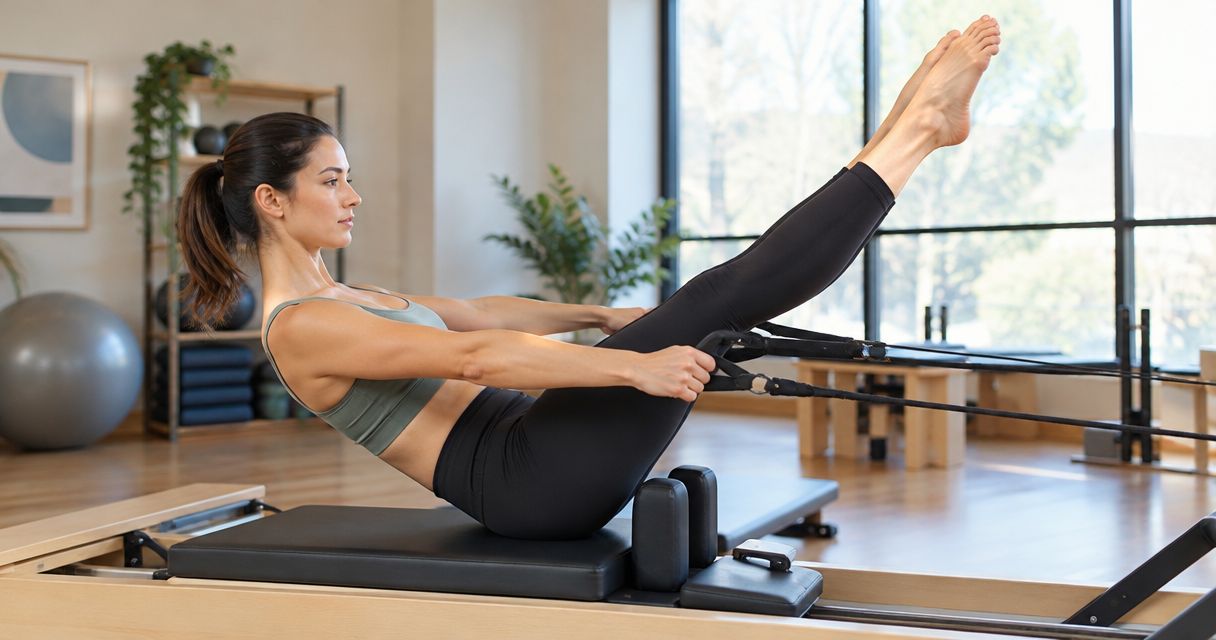
Good form follows the purpose of the exercise and the instructions for your body and setup. It is not a single posture that you hold throughout every class. Different exercises ask you to move different joints while controlling others.
For your 2026 practice, use 3 movement checkpoints as conversation starters with your instructor:
- Carriage control: Move deliberately in both directions rather than letting the return happen without attention.
- Intended alignment: Follow the positioning your instructor gives for that exercise rather than copying another participant’s shape.
- Steady breathing: Keep breathing through the movement instead of using breath-holding to force a repetition.
These checkpoints are not a self-certification test. An instructor can observe details that are difficult to assess while you are moving, including whether you are compensating somewhere else.
Notice the difference between completing a movement and controlling it. If the final repetition looks very different from the first, ask whether to reduce the range, pause, or change the exercise.
Why the time to learn Reformer Pilates varies
Your learning process depends on what you are practicing and how you respond to instruction. These factors explain why a universal completion date is not a useful standard:
- Equipment familiarity: Learning the carriage, straps, footbar, and spring setup adds tasks beyond learning the movement itself.
- Exercise complexity: A familiar lying-down exercise and an unfamiliar standing exercise do not demand identical skills.
- Previous movement experience: Recognizing a breathing or alignment cue is different from applying it on moving equipment.
- Feedback: A clear correction gives you a specific change to practice rather than a vague instruction to improve.
- Practice continuity: Returning to familiar movements gives you opportunities to revisit the same cues.
- Your needs that day: Discomfort, fatigue, and difficulty concentrating are reasons to discuss adjustments, not reasons to force a harder version.
Do not turn these factors into a prediction about your ability. Use them to identify the next question to ask. If the equipment still feels unfamiliar, a more complicated exercise is not the next priority.
How should you approach your first class?
Start with preparation, not a performance goal. Before attending, confirm the class description, arrival instructions, clothing guidance, and whether the studio requires particular footwear or equipment. Do not assume that instructions for a heated class also apply to Reformer Pilates.
Bring water and wear clothing that lets you move without repeatedly adjusting it. Confirm any additional requirements directly with the studio rather than buying accessories based on a generic checklist.
Tell the instructor that you are new to the reformer. Share relevant movement limitations before class, and ask how to pause safely if you lose track of an instruction.
Your first-class goal is to understand the setup and follow the movement safely—not to keep up at any cost. You do not need to memorize every cue immediately. Leave knowing which instruction deserves your attention next time.
For a 2026 beginner, that is a more useful starting point than choosing an arbitrary mastery date.
How can you make each class useful?
Give yourself a repeatable process instead of a deadline. The sequence below keeps your attention on something you can discuss and practice.
- Name your goal. Tell the instructor which movement or instruction confused you previously. Make the question specific enough to answer.
- Choose one cue. Work with the instructor to select a cue you can remember during the exercise. Avoid trying to correct everything at once.
- Practice deliberately. Apply that cue in the version of the movement the instructor recommends. Do not add complexity just because the exercise feels familiar.
- Ask for feedback. Check whether the adjustment changed the intended part of the movement. Your impression and the instructor’s observation are both useful to discuss.
- Record your takeaway. After class, write down the exercise, the cue, and your next question in plain language.
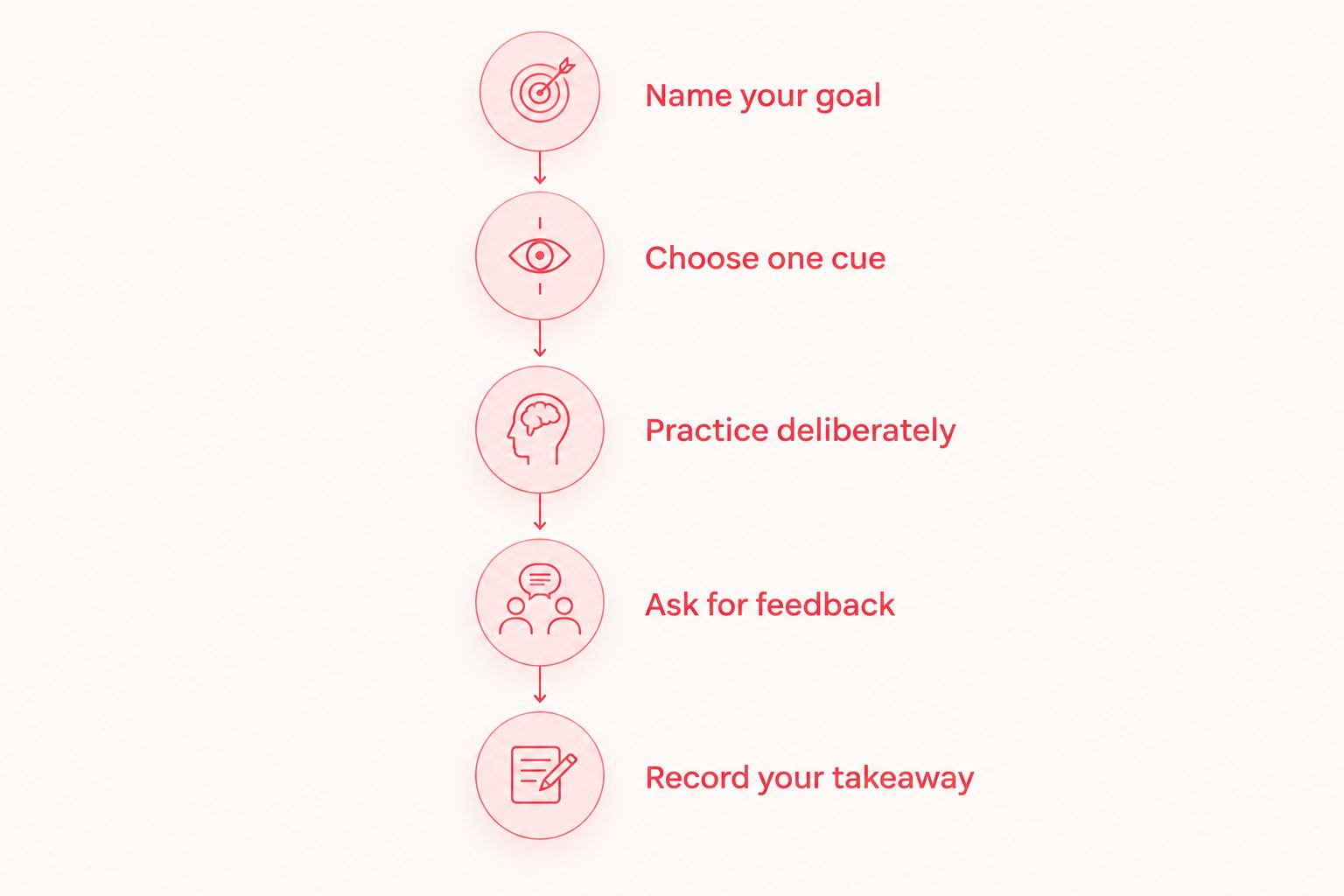
Use 1 cue per exercise as a starting recommendation when several corrections feel overwhelming. This is an attention strategy, not a rule about how many instructions you are allowed to receive. Ask the instructor which correction takes priority.
Keep your notes brief enough that you will actually revisit them. A useful note identifies an action; a judgment such as being bad at Pilates does not tell you what to do differently.
Does more spring resistance mean better form?
More spring resistance is not a universal progression rule. Springs can provide resistance, assistance, or support depending on the exercise. The appropriate setup depends on what the movement is intended to teach.
Ask the instructor which setting to use and why. Do not copy a neighboring reformer or change the springs simply to make the exercise feel harder.
The same principle applies to range of motion. Reaching farther is not an improvement if you lose the alignment or control the exercise requires. Practice the range your instructor recommends, then ask what needs to remain steady before you increase it.
Treat equipment changes as part of instruction, not a scorecard. A setting that suits one exercise does not establish the right setting for the next.
When are you ready for a more challenging exercise?
Readiness starts with repeatability. Can you follow the setup, understand the main cue, and perform the familiar version without repeatedly losing the intended movement? Ask your instructor to assess that before changing the challenge.
Use 2 questions after class to make the decision concrete:
- What should stay the same when this exercise becomes more challenging?
- What would tell me to return to the simpler version?
These questions make progression specific. Rather than asking whether you are advanced, you are asking which skill supports the next movement.
For your 2026 learning plan, distinguish confidence from readiness. Feeling comfortable is useful, but it does not replace feedback. Equally, needing a reminder does not mean you have failed or must avoid every new exercise.
How often should you practice while learning?
Choose an attendance pattern you can sustain and discuss it with your instructor. There is no universal class frequency that guarantees mastery, and attendance alone does not tell you whether your technique is changing.
For readers in American Fork and nearby Utah County cities, include travel and preparation in that decision. A class time that fits your actual week is more useful than an ambitious plan you repeatedly abandon.
When considering a Unified Hot Yoga Reformer Pilates membership, separate the commitment decision from the mastery question. Review current membership information directly with the studio, then consider whether the attendance pattern fits your routine. A membership does not create a technique deadline.
Keep your 2026 progress record focused on instructions you understand and movements you can repeat. Avoid judging progress only by how exhausted you feel afterward.
Can you learn Reformer Pilates form without being flexible?
You do not need to demonstrate advanced flexibility before asking about a beginner-appropriate Reformer Pilates class. The practical question is which movements and ranges are appropriate for you, not whether you can match another person’s position.
Tell the instructor where movement feels restricted. Ask for guidance rather than forcing a range that changes the exercise or causes pain.
Flexibility and control are separate considerations. Being able to move farther does not establish that you can control the reformer through that range.
Should you stop if an exercise hurts?
Stop the movement and tell the instructor if an exercise causes pain. Do not use a mastery goal as a reason to push through it. Ask how to exit the position and whether an alternative is appropriate.
An instructor’s movement guidance does not replace medical assessment. If you have an injury, a medical condition, or restrictions from a healthcare professional, discuss those before participating and follow the relevant clinical advice.
The same practical approach applies when you feel overwhelmed rather than physically uncomfortable. Pause and ask for the setup again. Staying engaged with the instruction matters more than completing every repetition.
FAQ
How long to master reformer pilates if I am a complete beginner?
There is no universal timeline for a complete beginner to master Reformer Pilates. Track whether you understand the setup, control familiar movements, and apply instructor feedback rather than choosing a promised completion date.
How do I know whether my Reformer Pilates form is improving?
Look for repeatable carriage control, the intended alignment, and a clearer response to corrections. Ask your instructor whether the change you feel is producing the intended movement.
Do I need to be flexible before my first Reformer Pilates class?
Advanced flexibility is not a prerequisite for discussing a beginner-appropriate class. Tell the instructor about movement restrictions and ask which range is appropriate for each exercise.
Does using heavier springs mean I am getting better?
Heavier springs do not automatically mean better technique. Springs serve different purposes across exercises, so follow your instructor’s setup rather than treating resistance as a ranking.
What should I bring to my first Reformer Pilates class?
Bring water and wear clothing that lets you move comfortably. Confirm footwear, equipment, and arrival requirements directly with the studio before attending.
Can I practice reformer exercises on my own between classes?
Do not improvise unfamiliar reformer exercises or equipment settings without instruction. Ask your instructor which movements, if any, are appropriate for you to practice independently.
Does Unified Hot Yoga offer Reformer Pilates for different experience levels?
Unified Hot Yoga offers Reformer Pilates for practitioners of all skill levels in American Fork, Utah. Check the current class information and ask which session fits your experience before booking.
One last thing
Notice when you can recognize that a repetition needs adjusting. Being able to pause, name the problem, and ask a precise question is a useful learning skill—not evidence that you are falling behind.
At your next class, replace the question of when you will master everything with a smaller one: what should you understand better before you leave? That gives your instructor a clear starting point and gives you a practical reason to return.